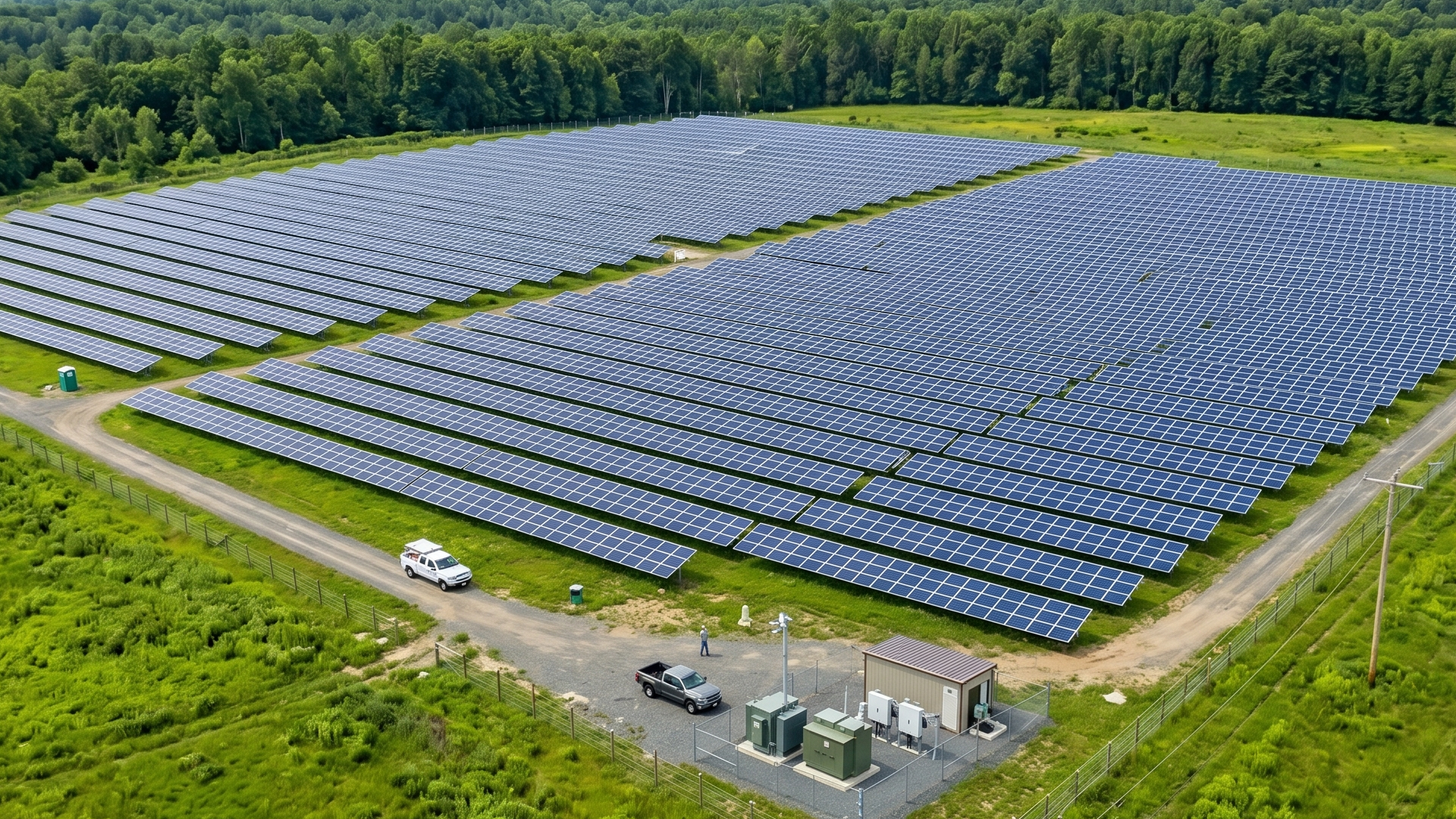
Greece offers strong solar-resource conditions — but expected photovoltaic yield must be calculated for the specific site, system design and operating assumptions; location-based tools such as the European Commission’s PVGIS are the appropriate starting point for technical assessment. The question is not whether Greece is a viable renewable energy market — it is whether the project is structured, connected and permitted correctly before capital is committed.
Why Investors Are Looking at Renewable Energy in Greece
Greece’s final National Energy and Climate Plan targets approximately 13.5 GW of solar PV, 8.9 GW of onshore wind and 1.9 GW of offshore wind capacity by 2030, with renewable energy expected to account for almost 81% of net domestic electricity generation. The policy direction — aligned with the EU Green Deal and REPowerEU — is unambiguous. What is less unambiguous, and where investments succeed or fail, is grid access, permitting sequence and revenue structure.
What Drives Returns in Solar, Wind and Battery Storage
There is no honest universal return figure for renewable projects in Greece — and any page that quotes one without a documented, project-specific basis should be read with caution. What actually determines the return of a solar, wind or storage project is a defined set of variables:
- Grid connection: the cost and terms of the connection offer, the availability of grid capacity at the specific location, and any injection or curtailment constraints.
- Revenue structure: corporate PPA, other bilateral offtake, merchant-market exposure, or — where available and awarded — an operating-aid mechanism; counterparty credit quality matters as much as the headline price.
- CAPEX and OPEX: technology, scale, land terms (purchase versus lease), balance-of-system costs, and long-term operations and maintenance.
- Financing: leverage, interest rates, and any bridge financing required by the timing of disbursements and certifications.
- Time and technical factors: permitting duration, module or turbine degradation, balancing costs, and taxation.
A credible investment case models these variables for the specific site and structure — it does not start from a generic percentage.
Grid Connection: The Critical Investment Constraint
In the current Greek market, the binding constraint for many new projects is not land or sunlight — it is electrical space. The terms and timing of a Final Connection Offer, the available capacity of the local network, and any injection limitations imposed on the project determine whether the theoretical economics can materialise. Grid due diligence belongs at the start of the evaluation, not the end
The Renewable Energy Permitting Path in Greece
Depending on the project category, the development path may include a Producer Certificate from the regulator (RAAEY) or an applicable exemption, environmental licensing, a Final Connection Offer and grid-connection agreement, an installation permit, and the required operational approvals. The sequence, documentation and timing vary materially by technology, capacity, location and available grid capacity — which is precisely why a generic timeline is not published here: a realistic, project-specific schedule is established during structured assessment.
When Development Law Support May Apply
This is where most online guidance overpromises — so here is the accurate position. Under Annex A of the Greek Development Law (L.4887/2022, as amended and currently in force, including L.5203/2025, Government Gazette A’ 87/02.06.2025, and L.5297/2026, A’ 64/28.04.2026), the energy production, distribution and infrastructure sector is in principle excluded from the aid schemes. The law provides specific exceptions — including small hydroelectric stations of up to 15 MW, high-efficiency cogeneration from renewable sources, hybrid RES stations in the electricity systems specifically identified by the law, renewable heating and cooling, energy-efficient district heating and cooling, and the production and storage of biofuels, bioliquids, biogas — including biomethane — and biomass fuels.
A standalone utility-scale solar park, wind farm or battery storage project does not, as a rule, receive a Development Law grant or tax exemption. Certain energy-related expenditures within a broader eligible investment may be supportable under specific conditions and provisions of the EU State-aid framework (Commission Regulation (EU) No 651/2014, as amended), and combined generation-plus-storage configurations are subject to special terms. Whether any of this applies to a specific project requires a formal case-by-case eligibility assessment. The Preliminary Readiness Screening determines whether such an assessment and a full mandate are appropriate; it does not provide an eligibility opinion or funding recommendation.
What Foreign Investors Must Prepare
Depending on the investment structure, a qualifying Greek entity or eligible branch; complete corporate and source-of-funds documentation, a grid and site file, and a revenue structure that stands without subsidy assumptions. Aggelakakis & Associates coordinates the structuring, regulatory and compliance workstreams — in coordination with qualified legal, tax and technical advisers — so that the investment decision is made on verified facts, not on assumptions.
Frequently Asked Questions
Can non-EU investors develop renewable energy projects in Greece?
Yes, subject to the applicable corporate, licensing, AML and — where relevant — foreign direct investment screening requirements. Greece’s FDI screening framework may apply to certain non-EU investments in sensitive sectors, including energy. The required structure and approvals depend on the investor’s origin, ownership profile and the specific transaction.
Does the Greek Development Law subsidise solar and wind parks?
As a rule, no. Energy production, distribution and infrastructure is in principle an excluded sector under Annex A of L.4887/2022, with specific exceptions such as small hydro up to 15 MW, high-efficiency renewable cogeneration, hybrid stations, renewable heating and cooling, and sustainable non-food biofuels. Eligibility of any energy-related expenditure is confirmed strictly case by case.
Is it possible to develop a renewable energy project in Greece without a Power Purchase Agreement?
Yes. A renewable energy project may be structured around a corporate PPA, another bilateral offtake arrangement, merchant-market revenues or, where available and awarded, an operating-aid mechanism. The appropriate route depends on the technology, project maturity, grid terms, counterparty credit quality and the regulatory framework in force at the relevant time.
To discuss a specific renewable energy project, request a Preliminary Readiness Screening at readiness@aggelakakis.gr — 30 minutes, no cost, no commitment.
This article is provided for general information purposes only and does not constitute investment, tax or legal advice. Eligibility, amounts and conditions depend on the applicable legal framework, aid scheme and call; the law, the call and the individual approval decision prevail. Legal framework as reviewed on 15 July 2026.