Skip to content
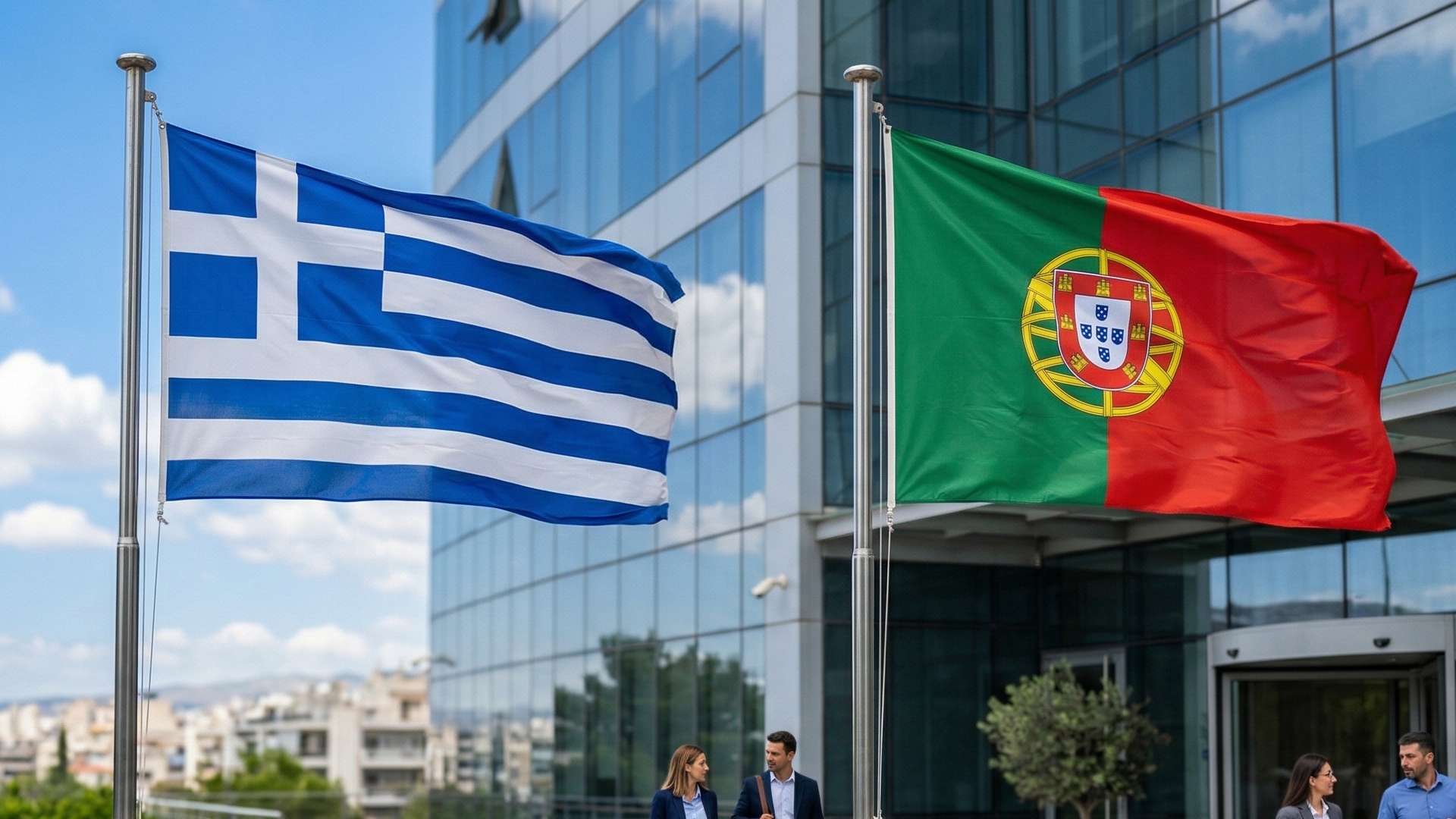
Greece attracted €4.5 billion in approved development investments in 2023 under its incentive framework. Portugal’s foreign direct investment fell 18% in the same year, according to Banco de Portugal. For investors weighing a Greece vs Portugal investment in 2026, the two markets offer fundamentally different structures, risk profiles, and returns. This guide compares both on incentive programmes, real estate yields, renewable energy conditions, and the practical realities of operating in each country.
Table of Contents
ToggleInvestment Climate — Greece vs Portugal in 2026
Greece’s GDP grew 2.3% in 2024, outpacing the EU average for the third consecutive year, according to the European Commission’s Winter 2025 Economic Forecast. The country has moved from a junk credit rating to investment grade across all four major agencies since 2023 — a structural shift, not a cyclical uptick.
Portugal entered 2025 with political uncertainty following its 2024 snap elections. Growth projections were revised down to 1.8% by the European Commission. The country remains a strong performer within the Iberian context, but its incentive framework for large-scale investors has narrowed since the abolition of the Non-Habitual Resident (NHR) tax regime in January 2024.
The headline difference: Greece has expanded its investment incentive architecture. Portugal has contracted its.
Incentive Programmes and Tax Treatment Compared
Greece — L.5203/2025 Development Law (Up to 70% Grant + 15-Year Tax Exemption)
Greece’s primary investment incentive framework is Law 5203/2025 (Government Gazette A’ 87/02.06.2023), which replaces the previous Development Law and substantially increases available support. It operates under EU Regulation 651/2014 (GBER) and covers twelve distinct aid schemes.
The maximum grant rate reaches 70% of eligible investment costs for projects in designated regions and qualifying sectors. That figure is not a ceiling in theory — it is the actual approved rate for projects in Zones A and B, which includes most of northern Greece and the islands. The scheme also provides a 15-year income tax exemption on profits equivalent to the approved grant amount.
Other aid forms under L.5203/2025 include leasing subsidy, employment cost subsidisation, and accelerated depreciation. Investors can select the combination that best fits their project’s financial structure. Eligible sectors include manufacturing, tourism, logistics, digital infrastructure, and renewable energy. Minimum investment thresholds start at €100,000 for small enterprises and rise to €500,000 for large enterprises in most schemes.
Applications are submitted through the digital portal of the Ministry of Development. Approval timelines average 60–90 days for well-structured submissions. The firm’s Thessaloniki office manages the end-to-end process for international clients, from feasibility assessment through disbursement.
Portugal — RFAI and Comparable EU-Compliant Schemes
Portugal’s main investment incentive is RFAI (Regime Fiscal de Apoio ao Investimento), a tax credit scheme administered through the Portuguese Tax Authority. It provides a tax credit of 25% on eligible investments up to €15 million, reducing to 10% on amounts above that threshold, in designated interior regions. The mechanism is a credit against corporate income tax — not a direct grant.
The Portugal 2030 co-funded programme supplements RFAI with grant support for specific sectors, primarily manufacturing, R&D, and sustainability-linked projects. However, grant rates are substantially lower than Greece’s framework, and the application process has become more competitive since the programme’s 2021 oversubscription.
The abolition of the NHR regime removes a major draw for high-net-worth individuals relocating to Portugal. Its replacement, IFICI (Incentivo Fiscal à Investigação Científica e Inovação), is narrower in scope and targets qualified professionals rather than passive investors.
Greece vs Portugal Investment 2026: Direct Comparison Table
| Factor | Greece | Portugal |
|---|---|---|
| Maximum grant rate (Development/Investment scheme) | Up to 70% (L.5203/2025) | Up to 25% tax credit (RFAI) |
| Tax exemption on profits | Up to 15 years (L.5203/2025) | None equivalent post-NHR |
| GDP growth forecast 2025 (EC) | 2.3% | 1.8% |
| Average prime commercial real estate yield (2024) | 5.8–7.2% (Athens, Thessaloniki) | 4.5–5.5% (Lisbon, Porto) |
| Solar irradiance (kWh/m²/year) | 1,600–1,900 | 1,600–1,800 |
| Golden Visa programme status | Active (restructured 2023) | Effectively suspended for real estate |
Real Estate and Tourism Investment
Athens prime residential yields averaged 5.2% in 2024, according to data from the Bank of Greece. Thessaloniki, the country’s second-largest city and a major logistics and services hub, offers commercial yields of 6–7.2% on well-located assets. Both markets remain significantly underpriced relative to comparable Southern European cities.
Portugal’s Lisbon market has repriced significantly over the past decade. Entry costs for prime residential assets have risen 140% since 2015, compressing yields. Porto offers slightly better entry points, but the gap versus Athens or Thessaloniki on a yield-to-cost basis is substantial.
Greece’s tourism sector adds another dimension. The country recorded 32.7 million international arrivals in 2023, generating €20.6 billion in revenue (Bank of Greece). Hotel and short-term rental assets in the Cyclades, Crete, and the northern coast offer occupancy-driven returns that exceed standard residential benchmarks. Development Law grants apply to qualifying tourism investments — a combination that does not exist in Portugal’s current framework.
Portugal’s Algarve and Alentejo regions retain genuine appeal for tourism investment. However, the removal of real estate from the Golden Visa programme has reduced liquidity and foreign buyer depth in those markets.
Renewable Energy: Which Market Offers Better Returns?
Both countries receive comparable solar irradiance — Greece averages 1,700–1,900 kWh/m² annually in the south, Portugal 1,600–1,800 kWh/m². On raw resource, they are close. The difference lies in the regulatory and incentive structure.
Greece’s Regulatory Authority for Energy (RAE) has licensed over 6 GW of new solar and wind capacity since 2022. The development pipeline remains open. Feed-in premium contracts (sliding-scale CFDs) provide revenue certainty for projects above 1 MW. Development Law grants under L.5203/2025 apply to renewable energy projects — meaning a solar park investor can stack a 45–55% capital grant on top of a feed-in premium contract.
Portugal’s RESP (national grid operator, REN) has issued capacity warnings for certain regions due to grid saturation. New licensing rounds have slowed in 2024–2025 as grid reinforcement catches up with the installed base. This creates queue risk for new entrants that did not exist three years ago.
For an investor looking at first entry into Southern European renewables, Greece’s pipeline availability and grant stacking create a clearer pathway to returns. The Munich office advises German institutional clients on exactly this combination — grid-connected solar projects structured under the Development Law.
The Practical Factors Investors Rarely Discuss
Due diligence timelines differ substantially. Greek title searches and land registry clearance have historically been slow. Since 2022, the Hellenic Cadastre has accelerated digitisation, and most urban properties in Athens and Thessaloniki now have clear digital title records. Rural land and island properties still require more thorough searches. Budget for 60–90 days of legal due diligence on any real estate transaction.
Portugal’s property registration system is more mature. Typical due diligence completes in 30–45 days. That efficiency advantage is real — but it is priced into the market. Faster process, lower yield.
Banking access for non-resident investors has improved in both countries. Greece’s four systemic banks (National Bank, Eurobank, Alpha Bank, Piraeus) all operate business banking for international clients in English. Corporate account opening typically takes 3–6 weeks with proper documentation.
Language is rarely an obstacle at the professional level in either country. Where it matters is in navigating government application portals, regulatory correspondence, and local authority approvals — all of which are conducted in the national language. An advisory firm with native-language capability and in-country representation is not optional for Development Law applications; it is the difference between approval and rejection.
Greece also benefits from its EU membership context: it receives substantial cohesion fund allocations through 2027, which flow into infrastructure, digital connectivity, and πράσινη μετάβαση projects. These programmes create secondary investment opportunities in supply chain and services sectors that are harder to find in a more saturated market like Portugal.
Frequently Asked Questions
Question: Is Greece or Portugal better for a €2M investment in 2026?
Answer: Greece offers stronger direct incentives for a €2M investment in 2026. Law 5203/2025 provides grants up to 70% of eligible project costs and a 15-year tax exemption — neither of which exists in Portugal’s current framework. Portugal has a more mature property market and faster due diligence timelines, but entry costs are higher and yields are lower. For investors prioritising capital efficiency and incentive stacking, Greece has the structural advantage this year.
Question: Can I combine a Development Law grant with a real estate or renewable energy project in Greece?
Answer: Yes. Law 5203/2025 covers qualifying tourism and hospitality investments as well as renewable energy projects, including solar and wind. An investor can receive a capital grant of 45–70% on eligible costs while also benefiting from the 15-year tax exemption on profits. The grant schemes are subject to GBER compliance (EU Regulation 651/2014) and require a formal application through the Ministry of Development portal. Professional advisory support is required for international applicants.
Question: Is Portugal’s Golden Visa still available for real estate investors?
Answer: Portugal suspended real estate from its Golden Visa programme in October 2023. Qualifying investment routes now focus on fund subscriptions, job creation, and cultural contributions. Greece’s Golden Visa programme remains active and was restructured in 2023 — it now requires minimum real estate investment of €800,000 in high-demand areas (Athens, Thessaloniki, Mykonos, Santorini) and €400,000 in other regions.
Which Market Fits Your Investment?
Portugal is a mature, liquid market with strong institutional infrastructure. If your primary goal is capital preservation in a familiar Western European environment, it remains a credible choice. But the incentive architecture has weakened significantly since 2023, and entry costs are high relative to yields.
Greece offers better capital efficiency in 2026. The combination of Law 5203/2025 grants, real estate yields above the Southern European average, and an open renewable energy pipeline creates conditions that are difficult to replicate elsewhere in the EU. The risk factors — due diligence timelines, bureaucratic complexity — are real, but they are manageable with the right in-country support.
For investors considering a qualifying project under the Greek incentive framework, the Αναπτυξιακού Νόμου page sets out the twelve aid schemes, eligible sectors, and application process in full detail.